
India’s evolution from a generics manufacturer into an innovation-driven life sciences hub is creating a structural, multi-decade opportunity for foreign pharmaceutical equipment and technology companies.

India’s evolution from a generics manufacturer into an innovation-driven life sciences hub is creating a structural, multi-decade opportunity for foreign pharmaceutical equipment and technology companies. This article maps the evidence, identifies the highest-potential segments, and sets out implications for market entry.
Three signals worth acting on
Yet investment decisions are not made against reform agendas. They are made against what firms actually experience when they register a company, secure land, obtain a permit, connect power, clear goods, hire workers, or enforce a contract. The gap between government intent and firm experience is where reform programmes lose credibility — and where execution determines whether capital moves.
01
India's imports of HS 847990 machinery grew at an 9.5% CAGR between 2016 and 2025 — faster than pharmaceutical export growth over the same period — signalling rising capital intensity in Indian pharmaceutical manufacturing.
02
China and Germany alone account for over half of India's top-10 machinery imports by value. The top three suppliers — China, Germany and Japan — cover approximately 63% of the total, leaving a narrow but real opening for new entrants in higher-specification categories.
03
India's move into sterile injectables, biologics and CRDMO services is creating demand for equipment categories where Indian and Chinese suppliers have limited capability — and where European, US and Japanese manufacturers hold a structural advantage.
A doubling export base driving sustained capital investment
India is the world’s third-largest pharmaceutical producer by volume, up from seventh in 2019, with more than 3,000 companies and 10,500 manufacturing units. The country supplies approximately 20% of global generic drug exports by volume, fulfilling roughly 40% of US generic demand, around a quarter of Europe’s, and a substantial share of Africa’s generics requirement. It is among the world’s largest suppliers of antiretroviral drugs.
This is the central lesson from regulatory reform work across South and Southeast Asia. Across different markets and reform models, the pattern is consistent: the binding constraint is rarely reform intent. It is the point at which reform fails to change the experience of firms.
India’s pharmaceutical exports excluding APIs reached approximately $25.8 billion in 2025.The broader sector has built a healthy trade surplus and remains one of the largest contributors to India’s manufacturing gross value added. Over the past decade, global pharmaceutical demand has expanded steadily, while India’s pharmaceutical exports have grown at a broadly comparable or marginally faster pace.
This export machine requires capital equipment, and India’s domestic capital goods sector cannot supply most of what the highest-value segments require. That gap — and the trade data that reveals it — is the starting point for this analysis.
What HS 847990 machinery imports tell us
To assess machinery import trends directly, this analysis uses HS 847990 — parts of machines and mechanical appliances, not elsewhere specified — which includes the sub-heading HS 84799040, covering machinery used for the manufacture of chemicals and pharmaceuticals. This is the most granular tariff line available in public trade data for pharmaceutical manufacturing equipment.
Because machinery imports and pharmaceutical exports sit on entirely different scales — hundreds of millions of dollars against tens of billions — comparing them directly would be misleading. Indexing both series to a common base year of 2016 makes the relative growth trajectories directly comparable.
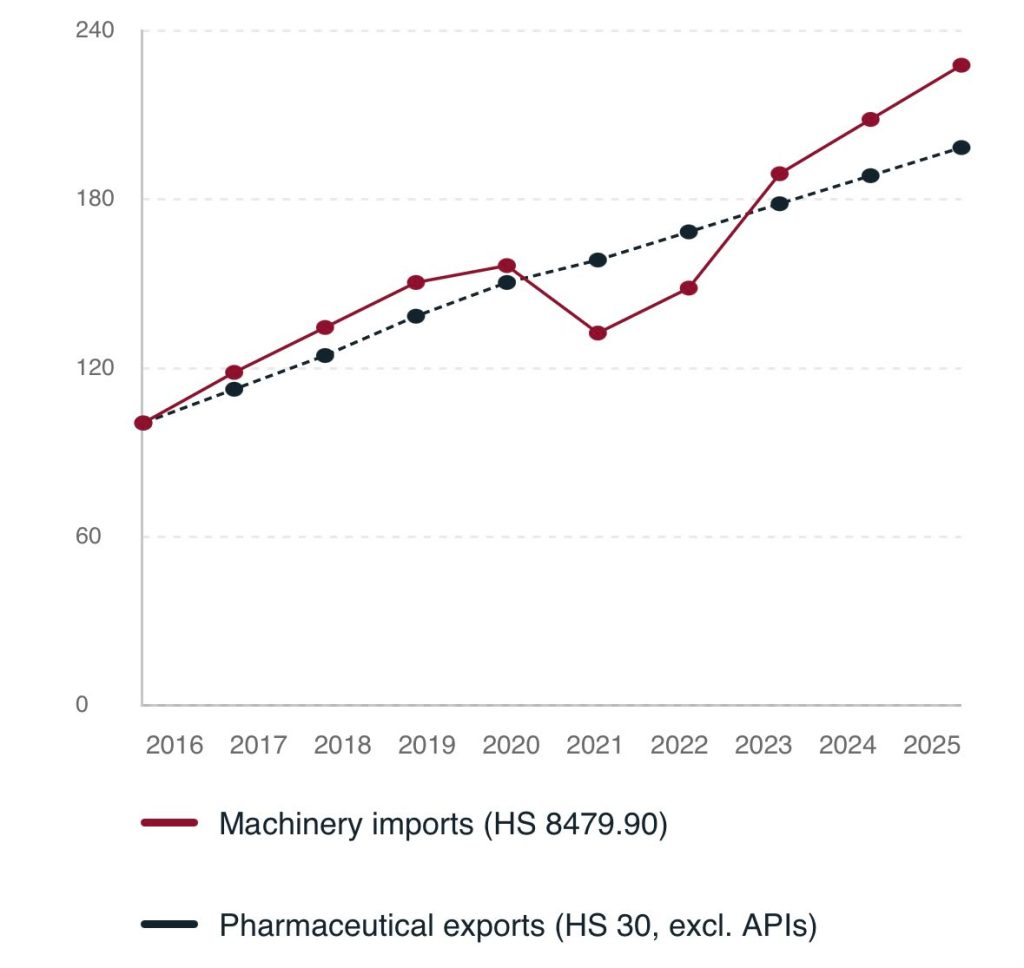
HS 8479.90: Parts of machines and mechanical appliances, n.e.s., including HS 8479.90.40 — machinery for manufacture of chemicals and pharmaceuticals. Pharmaceutical exports: HS 30, excluding APIs. Source: ITC Trade Map — India trade statistics, HS 8479.90 and HS 30.
Over 2016–2020, the two series moved in step, with machinery imports tracking export growth closely. From 2021 the lines diverge: machinery imports dipped through the pandemic-disrupted period before accelerating sharply from 2022, while exports continued to climb at a steadier pace. By 2023, the machinery import index had reached 188.7, overtaking the export index, and by 2025 it stood at 227.3 against an export index of 198.0. In absolute terms, machinery imports rose from $415 million in 2022 to $708 million in 2025 — a 70.5% increase in three years, against a CAGR of roughly 9.5% for machinery imports compared with 7.9% for pharmaceutical exports over 2016-2025.
This matters because equipment demand is now growing faster than pharmaceutical output. That is rarely explained by volume expansion alone. Instead, it reflects a structural shift toward higher-value manufacturing requiring substantially greater capital investment per unit of output.
From standard generics to sterile injectables and biologics
India has historically dominated solid oral dosage forms — tablets and capsules — where manufacturing equipment is standardised and competitively supplied domestically and by Chinese exporters. The shift underway is toward sterile injectables, biologics, biosimilars and high-potency APIs — segments where Indian domestic equipment manufacturers have limited capability and where European suppliers hold a decisive competitive advantage.
The CRDMO sector is the most visible expression of this shift. India’s CRDMO industry generated $3–3.5 billion in 2024, capturing just 2–3% of a $140–145 billion global market. It has grown at a 15% CAGR between 2019 and 2024, roughly double the 7–8% global rate. A small base, fast growth, and a market that is still mostly unclaimed — this combination is why equipment demand is rising so quickly. Companies are building new capacity, not just running existing plants harder.
Four structural tailwinds explain why. Global supply chains are actively derisking away from China. Industry estimates point to $10-15 billion of CRDMO demand realigning over the next five years, of which India is positioned to capture roughly $5 billion directly. US pricing pressure, including the Inflation Reduction Act, is accelerating offshoring. In a BCG survey of 200+ global biotech and pharma customers (February 2025), 83% agreed the Inflation Reduction Act would positively impact offshoring to India.
India’s innovation ecosystem is also strengthening, backed by more than ₹25,000 crore in government schemes such as BIRAC and the Promotion of Research and Innovation in Pharma MedTech (PRIP) programme, with more than 40 Indian startups now active in NCE and NBE research. And new modalities are expanding fastest of all: global revenue from advanced modalities is growing at a 20–50% CAGR through 2028, with gene therapy (50%), cell therapy (42%), DNA and RNA therapeutics (36%) and antibody-drug conjugates (26%) among the fastest-growing categories.
Advanced modalities do not run on the same equipment base as small-molecule generics: single-use bioreactors, sterile fill-finish lines, cell and gene therapy platforms, and high-containment handling systems for ADCs and high-potency APIs are capital-intensive and, in large part, not yet manufactured competitively in India. Hyderabad’s Genome Valley — described in industry analysis as India’s first dedicated biotech cluster, supported by Telangana government incentives including concessional SEZ land rates and workforce upskilling initiatives under the World Economic Forum’s C4IR Telangana programme — is one of the clearest examples of this shift taking physical shape.
The capital implications are explicit rather than inferred. India’s CRDMO sector needs to increase annual capital investment roughly 4–5x over the next decade, from an average $0.4-0.5 billion added per year over FY21-24 to $1.3-2.4 billion required annually through FY35, simply to capture the growth already in motion. If India’s CRDMO industry reaches its projected $22–25 billion potential by 2035, that capital will overwhelmingly be spent on equipment India cannot yet build for itself.
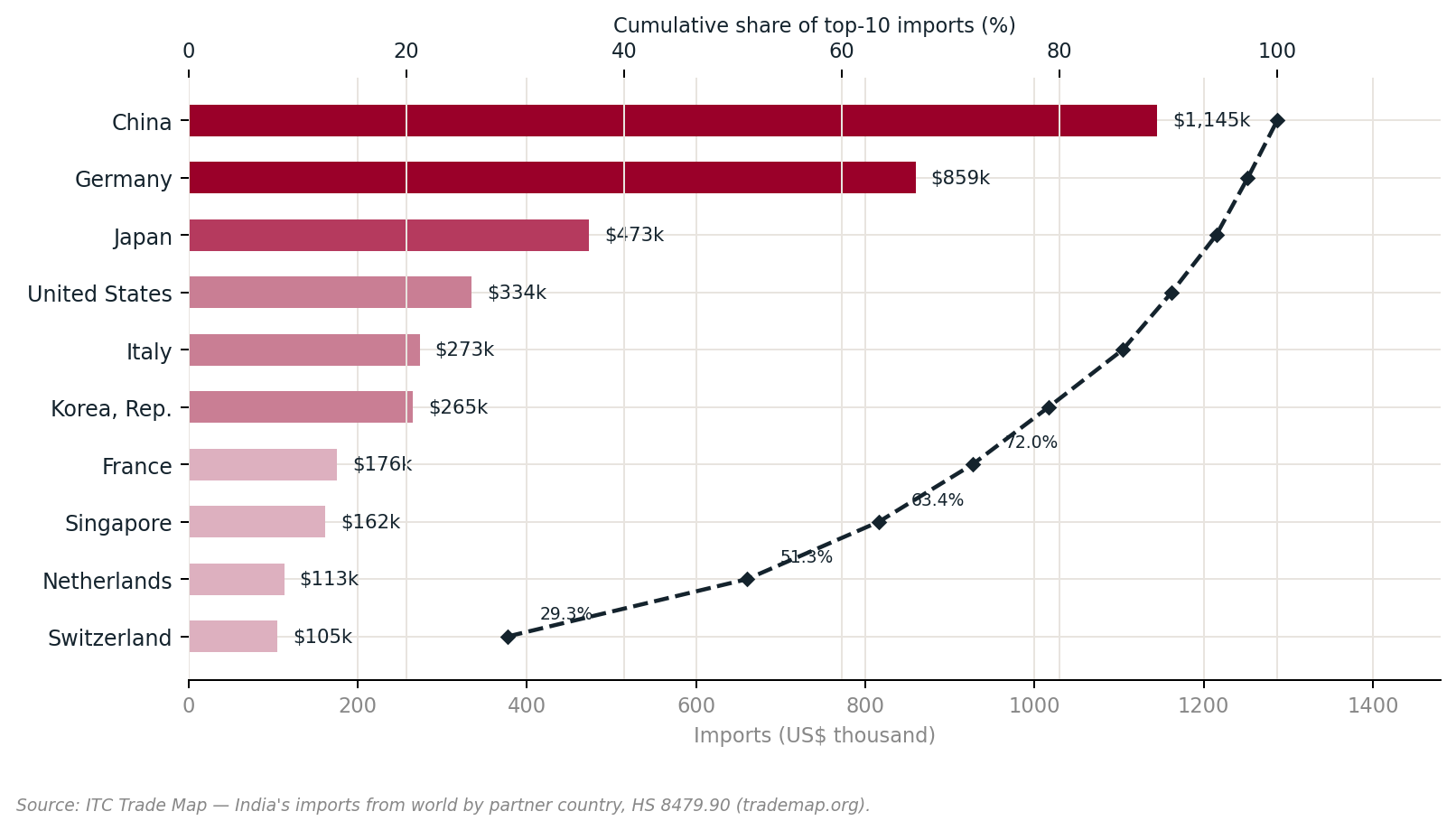
The Pareto pattern is unambiguous: China and Germany together supply just over half of India’s machinery imports among the leading ten origin countries, and the top three — China, Germany and Japan — account for roughly 63%. By the time the top five suppliers are included (adding the US and Italy), cumulative share reaches nearly 79%.
China’s leadership reflects cost-competitive, standardised equipment for conventional generics manufacturing — exactly the segment India is moving away from. Germany, Japan and the US combined share reflects demand for higher-precision equipment: sterile filling lines, bioprocessing systems and analytical instrumentation associated with the value chain shift described above.
For foreign manufacturers, this points to a specific opening rather than an open field. Competing head-on with China on price for standard equipment is unlikely to be a winning strategy. The more durable opportunity lies in higher-specification categories where European, Japanese and US suppliers already hold share but where India’s CRDMO and biosimilars expansion is growing the addressable market faster than any single incumbent can currently scale to meet it.
A structural change in the competitive calculus
The India–EU Free Trade Agreement, concluded on 27 January 2026 after nearly two decades of negotiations, will eliminate Indian tariffs on machinery — currently as high as 44% — for most products, with half liberalised at entry into force and the remainder phased over up to ten years.[8] Tariffs on pharmaceuticals and chemicals will be nearly eliminated, and the large majority of medical device product lines will move to zero tariff.
Three implications stand out for equipment exporters. First, tariff liberalisation directly improves the landed cost economics of direct exports from the EU. Second, regulatory cooperation clauses begin to address the inspection and certification friction that has historically complicated market access. Third, the agreement is not yet in force: manufacturers planning market entry around the FTA should build a 2026–2027 ratification timeline into their planning
The agreement is the largest bilateral FTA either party has concluded and is expected to materially reduce India’s tariff burden on EU exports. It remains subject to legal scrubbing and ratification, with entry into force expected in late 2026 or early 2027. The agreement also incorporates pharmaceutical-specific regulatory cooperation clauses — a first step toward addressing the non-tariff barriers that have historically constrained European market access in India.
For foreign manufacturers and exporters
Taken together, the trade data, the value chain shift and the supplier concentration analysis point toward a market that is growing, structurally changing in composition, and genuinely open to new entrants in its higher-specification segments.
Build for the innovation layer
Emerging demand from pharmaceutical R&D operations, pilot-scale manufacturing, and the expanding network of CRDMOs is creating new demand for laboratory automation, Process Analytical Technology (PAT) systems, digital twins, and AI-enabled quality inspection solutions.
India’s life sciences innovation ecosystem is strengthening rapidly. Patent filings in life sciences increased from 440 in 2013 to 3,576 in 2023, significantly outpacing growth in traditional pharmaceutical innovation hubs such as Germany and Switzerland, and placing India seventh globally in life sciences patent filings.[9] This evolution suggests that future demand will increasingly extend beyond conventional manufacturing equipment towards advanced technologies supporting research, process optimisation, digital manufacturing and next-generation pharmaceutical production.
Localisation considerations
The India–EU Free Trade Agreement has the potential to create a more favourable environment for direct exports of pharmaceutical manufacturing equipment by lowering tariff barriers and encouraging technology partnerships.
However, market entry will continue to depend on navigating India’s regulatory environment. Pharmaceutical equipment supplied to Indian manufacturers must comply with the requirements of the Central Drugs Standard Control Organisation (CDSCO) and Indian Good Manufacturing Practice (GMP) standards. For many foreign manufacturers — particularly those entering India for the first time — developing a local regulatory affairs capability, either through an in-house team or an experienced local partner, should be viewed as a prerequisite for successful market entry rather than an optional investment.
The opportunity has two distinct halves — equipping the CRDMO-led manufacturing build-out, and equipping the emerging innovation layer behind it. Manufacturers that localise regulatory capability early will be positioned to capture both as the India–EU FTA lowers the cost of entry.
Trade data indexed and analysed from ITC Trade Map — India trade statistics, HS 8479.90 and HS 30 (pharmaceutical exports excluding APIs). Supplier concentration from ITC Trade Map, India’s imports from world by partner country, HS 847990.
Sector and CRDMO figures draw on industry analysis and market estimates as cited in the text, including a BCG survey of 200+ global biotech and pharma customers (February 2025). Government scheme figures (BIRAC, PRIP) and life sciences patent-filing data are as referenced inline. India–EU FTA terms per the agreement concluded 27 January 2026, subject to legal scrubbing and ratification.
Notes [8] and [9] in the text refer to the source article’s own references, retained here as published.
Most emerging economies have the ingredients of an innovation economy. The challenge is connecting them into a system that helps firms scale and creates jobs.
Capital responds less to reform intent than to the time, cost, predictability, and trust firms experience on the ground
Save or print this case study for offline reading