
Most governments know what needs to change. The harder question is whether reform changes what firms actually experience. That is where investment decisions are made — and where five execution shifts matter most.


Most governments in emerging economies no longer need to be convinced that the business environment matters. They have reform agendas, digital initiatives, policy commitments, and delivery targets. Many are technically sound. Some are backed by Cabinet decisions, development-partner finance, or new institutional mandates.
Yet investment decisions are not made against reform agendas. They are made against what firms actually experience when they register a company, secure land, obtain a permit, connect power, clear goods, hire workers, or enforce a contract. The gap between government intent and firm experience is where reform programmes lose credibility — and where execution determines whether capital moves.
This is the central lesson from regulatory reform work across South and Southeast Asia. Across different markets and reform models, the pattern is consistent: the binding constraint is rarely reform intent. It is the point at which reform fails to change the experience of firms.
In Sri Lanka, a national reform action plan showed that the constraint was not generic “red tape,” but permits, handoffs, data-sharing failures, and manual back-office processes. In India, state-level reform benchmarking showed how visibility and comparison can turn coordination into competition. In the Philippines, sector diagnostics in renewable energy, mobile towers, and data centres showed that binding constraints often sit inside specific approval chains, not in broad national reform checklists. In Bangladesh, a home-grown business climate index showed the value of measuring firm experience by sector and geography rather than relying only on global indicators.
The pattern is consistent. Reform matters when it changes the time, cost, predictability, and trust that firms experience on the ground. It matters less when it stops at new rules, portals, committees, or action plans.
That distinction is becoming more important. Emerging economies need capital for factories, ports, renewable energy, data centres, logistics, digital infrastructure, tourism, and services. But capital remains selective. Investors do not reward reform intent. They respond when the operating environment becomes sufficiently predictable for them to commit money, management time, and reputation.
For governments and development partners, the implication is practical: the next generation of regulatory reform should be judged less by the number of actions completed and more by whether firms can see the difference. Five execution shifts matter most.
The prize is large. The conversion rate is not.
The investment gap is not small. Emerging economies need roughly a trillion dollars a year in external climate investment alone by 2030. They also need capital for industrial production, logistics, ports, renewable energy, data centres, tourism, urban infrastructure, and services. Yet the capital that does reach emerging markets remains both insufficient and highly concentrated.
Across all forms of foreign investment, 129 emerging economies receive about $683 billion a year. Half of that goes to just five countries. The issue, therefore, is not simply that emerging markets receive too little investment. It is that too few of them are able to convert reform effort, market potential, and investor interest into committed capital.
The trend line is equally sobering. Foreign investment into developing economies rose from $609 billion in 2010 to $867 billion in 2024 — a 42 percent increase in nominal terms over fourteen years. Adjusted for inflation, that is close to standing still. Over the same period, business-environment reform became a core policy agenda across much of the developing world.
That gap matters. Many governments have invested heavily in reform plans, digital platforms, one-stop shops, investment-promotion agencies, and new policy commitments. But the broad-based investment response has been limited. The poorest countries, home to around a tenth of the world’s population, still receive only about 2.4 percent of global foreign investment.
The uncomfortable implication is that reform activity has outpaced reform conversion. Governments may be doing more, but firms are not always experiencing enough change to alter investment decisions. For policymakers and development partners, the question is therefore not whether regulatory reform matters. It is why so much reform effort produces so little visible movement in capital flows.
The answer begins with execution. Capital does not respond to the presence of a reform agenda. It responds when the operating environment becomes sufficiently predictable for firms to commit resources, management attention, and risk. That requires moving beyond whether reforms have been announced, completed, or digitised — and asking whether they have changed the experience that firms face on the ground.
The investment pool remains too small — and too concentrated.
Inward foreign direct investment flows. Panel A uses UN Trade and Development’s own “developing economies” grouping. Panel B is a 2022–24 average across 129 emerging economies, excluding offshore financial centres, whose flows are larg ely conduit rather than real investment. Source: UNCTAD; Athaag analysis.
Why technically sound reform plans still fall short
Governments rarely lack reform agendas. Most have detailed plans, policy commitments, digital initiatives, and delivery targets. The harder problem is that many of these reforms do not reliably translate into a different experience for firms. In other words, the issue is not only whether a reform is completed, but whether it changes the time, cost, predictability, and discretion that businesses face.
Evidence from multiple sources points to the same conclusion. The World Bank’s own evaluators found that improvements in Doing Business rankings were inconsistently linked to economic outcomes and weakly predictive of investment. Other research reached a similar finding: large jumps in rankings did not reliably attract more foreign investment. The Donor Committee for Enterprise Development makes the broader point well: business-environment reform can help mobilise private capital, but the relationship is neither automatic nor uniformly strong.
Our analysis reinforces that pattern. Countries that opened more sectors to foreign investors between 2018 and 2024 did not consistently receive higher investment inflows. Recent OECD work adds a further nuance: deregulation in retail and professional services improved downstream productivity, but had limited effect on investment. Taken together, the evidence suggests that reform design can improve the rules of the game, but capital responds only when implementation changes how the game is actually played.
The Netherlands illustrates the execution gap. The government set a target to reduce administrative burdens on business by 25% and met it in 2007. Yet many businesses remained dissatisfied. The OECD’s review found that governments can meet burden-reduction targets by removing rules that are easiest to remove, including obsolete rules that no longer affect business decisions. The metric improves, but the experience may not.
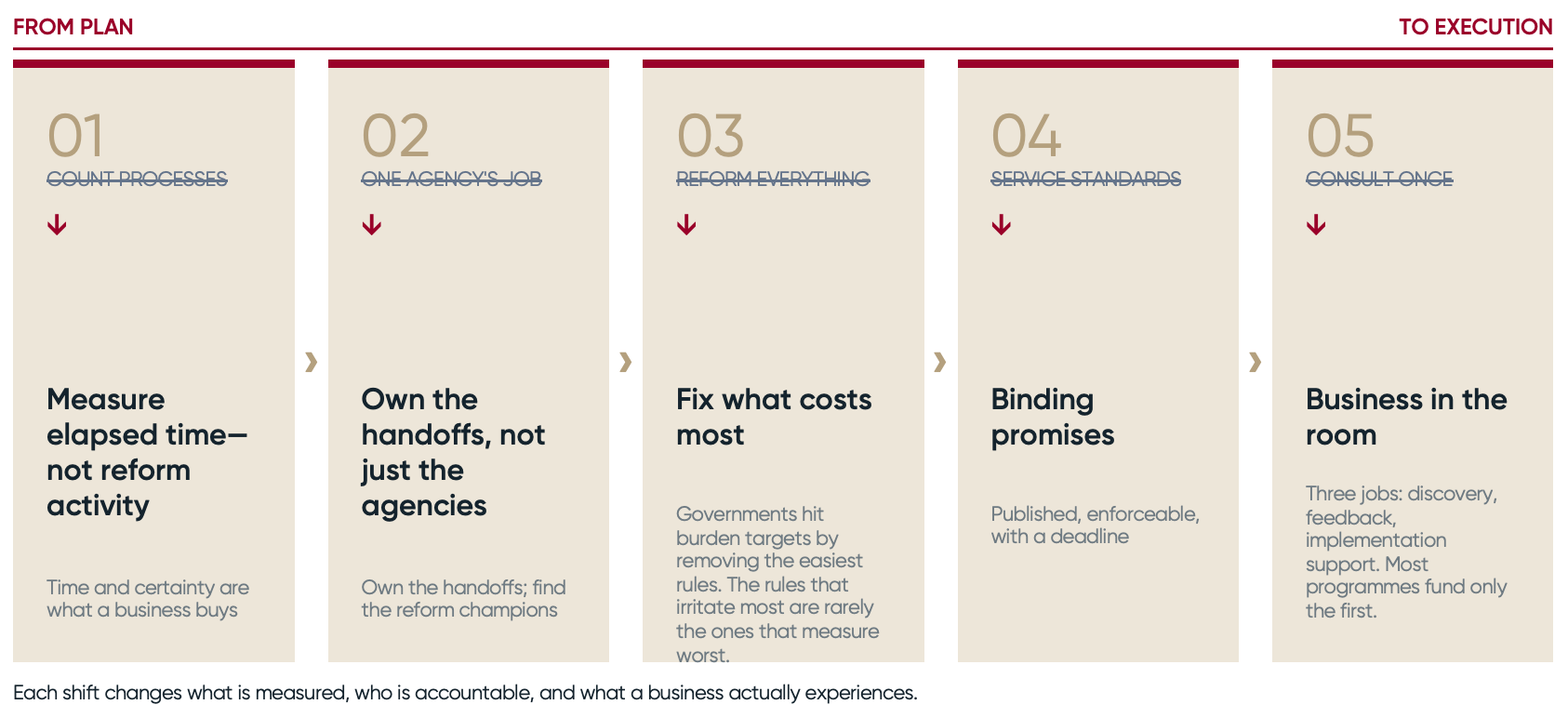
That is the central challenge for the next generation of regulatory reform. It is not enough to complete actions, launch systems, or revise rules. Reform must reach the point where firms make decisions. Closing that gap requires five practical shifts.
Five shifts separate a reform plan from a reform result.
Count the days a firm waits end to end — not the steps a plan removes.
The delay usually sits between offices, not inside one.
Rank reforms by what binds firms, not by what is easiest to count.
Firms hold the stopwatch — keep them in delivery, not just design.
Count the days a firm waits end to end — not the steps a plan removes.
Athaag framework, drawn from the sources cited throughout and from field experience on national regulatory reform programmes.
From reform plan to reform result
Measure elapsed time, not reform activity
Most reform plans count the visible activity of reform: steps removed, forms merged, portals launched, laws amended. Businesses experience something different. They experience elapsed time — the number of days between deciding to act and being allowed to proceed.
Time matters, but predictability matters just as much. An approval that reliably takes 30 days can be easier to invest around than one that averages ten days but sometimes takes 90. Capital is committed against a schedule: financing is drawn down, contractors are booked, equipment is ordered, leases begin, and customers are promised delivery. When the timeline is unknowable, every decision carries a buffer. That buffer is not an inconvenience. It is a cost — and it can determine whether the project proceeds at all.
This is why the most useful reform metric is not the time taken at each administrative step. It is the end-to-end timeline, measured from the applicant’s first approach to final approval, including the waiting time between offices. Published timelines do more than improve service quality. They reduce discretion. When an official controls an applicant’s schedule, the applicant may pay to regain control of it. Transparency about time is therefore an anti-corruption instrument as much as a customer- service measure.
Digital systems can help, but only when the delay is administrative. The World Bank’s Business Ready data show the distinction clearly. Registering a company takes about 30 days in economies without strong online systems and 12 days in economies with them — a gain of 18 days. For building permits, however, the pattern reverses: 66 days without strong systems and 78 days with them. The issue is not whether portals work. It is what kind of waiting they are being asked to remove.
The difference is intuitive. Company registration is largely paperwork; a portal can remove much of it. A building permit requires site visits, technical checks, sequencing across agencies, and judgement. A portal may reduce trips to the counter, but it will not automatically shorten an inspection queue or resolve a handoff failure.
The same reform tool produces different results depending on what the waiting is made of.

Correlation between each economy’s Pillar 2 score (the digital and administrative services supporting a function) and its Pillar 3 time score (how fast that function actually is), across 101 economies. Business Ready measures each economy’s largest business city, so it is a proxy for the economy rather than a full picture. Dispute-resolution timing is excluded: the fastest-scoring economies include several where courts are barely used, which makes the measure unreliable. Source: World Bank Business Ready 2025; Athaag analysis.
Cost behaves differently. Where digital systems are strong, both company registration and building permits tend to become cheaper, because businesses avoid agents, travel, photocopies, and informal counter costs. This matters, especially for small firms priced out of formality by intermediaries. But lower cost is not the same as shorter time. Digitalisation reliably reduces the cost of paperwork. It reduces time only when paperwork is the constraint.
Sri Lanka illustrates the point. Across consultations with more than fifteen agencies, the same pattern appeared repeatedly: online services at the front end, manual processes behind the counter; the same information filed separately with the company registry, labour fund, and tax authority; inspections demanded before the registration they were meant to follow; and provincial registries unable to see one another. These were not interface problems. They were process problems.
The implication is straightforward: digitalisation must be paired with process re-engineering. That means deleting steps that exist only because another step exists, running approvals in parallel rather than sequence, allowing low-risk applications to skip inspections, accepting another agency’s verification instead of repeating it, and abolishing forms wherever possible rather than digitising them. The cheapest form to process is the one nobody has to file.
A reform plan should therefore measure the same thing throughout: baseline days, target days, and actual days, all measured end to end from the applicant’s side. Digitise paperwork where paperwork is the constraint. Re-engineer everything else. Do not ask whether steps were removed or systems launched. Ask whether the firm experienced fewer days — and whether those days became more predictable.
Own the handoffs, not just the agencies
The second reason reform plans stall is that the delay rarely sits inside one office. It sits between them.
The pattern is familiar across emerging economies. A company registry, labour authority, and tax office collect the same information because they do not share data. An inspection is required before the registration it is meant to follow. Land and permit records sit in systems that cannot talk to each other. Foreign documents require embassy certification because digital identity is not trusted. These are not isolated agency failures. They are handoff failures.
The persistence of these handoffs is not always accidental. Political-economy research finds that weak delivery often reflects incentives and choices, not only limited administrative capacity. Delays can create rents, preserve discretion, or protect institutional turf. In plain terms: some queues survive because they serve someone.
The persistence of these handoffs is not always accidental. Political-economy research finds that weak delivery often reflects incentives and choices, not only limited administrative capacity. Delays can create rents, preserve discretion, or protect institutional turf. In plain terms: some queues survive because they serve someone.
This is why almost every serious regulatory system has some form of cross-government owner. The United States has the Office of Information and Regulatory Affairs. South Korea has a Regulatory Reform Committee reporting to the President, with private-sector members seated alongside officials. The United Kingdom combines a Better Regulation Executive with an independent Regulatory Policy Committee. The European Union has its Regulatory Scrutiny Board. Australia has the Office of Best Practice Regulation. Mexico has a federal regulatory improvement commission and register of formalities. Estonia addressed the data-sharing problem through X-Road. The institutional models differ, but the principle is the same: someone must own the handoffs and have enough authority to coordinate the agencies that create them.
A central body, however, cannot see every bottleneck in real time. Some are buried deep inside delivery: a form added informally, a circular interpreted too narrowly, a system outage, a document still requested after it has been abolished. Bottlenecks are discovered, not designed. That is why coordination must also be distributed. Each agency needs named reform champions with a mandate to identify problems, escalate them, and stay accountable until they are fixed. Not a committee seat. A job.
Those champions need incentives. Soft mechanisms — recognition, certification, and published benchmarking — create momentum and peer pressure. India’s Business Reform Action Plan showed how this can work in practice: a reform action plan, implementation guide, reporting portal, evidence validation, and public comparison turned state-level reform from an administrative exercise into a competitive delivery system. Hard mechanisms — written reform covenants, performance-linked funding, or conditional transfers — create consequence. Used together, they turn coordination from a meeting into a delivery system.
Own the handoffs, not just the agencies
Across recent reform programmes, the binding constraint was rarely the broad category called “red tape.” It was a more specific failure in process design, inter-agency coordination, measurement, or enforcement.
Fix the constraint, not the checklist
The third shift protects scarce political capital: do not try to fix everything. Find the constraint that actually changes firm behaviour.
Governments often struggle to make this choice. When reform targets are defined by the number of rules removed or the percentage of administrative burden reduced, the safest response is to remove what is easiest to remove. The OECD’s work on administrative simplification shows why this disappoints: obsolete rules can be deleted, low-friction requirements can be simplified, and the arithmetic can improve while the business experience barely changes.
A binding constraint is different. It is not necessarily the most visible rule, the longest form, or the step that appears most often in a reform tracker. It is the point at which firms delay investment, stay informal, avoid a market, abandon expansion, or price in risk. A requirement can be cheap to comply with and still be decisive. Another can dominate burden statistics and still be accepted by firms as reasonable.
That is why the constraint is rarely obvious from the capital city. Two practitioner examples make the point. In Southeast Asia, unlocking more venture capital turned out to have little to do with simplifying start-up licensing; the real constraint was the absence of a workable exit, which required changes to capital-market structures and listing rules. In Africa, mobilising institutional money into private equity was not best addressed by creating more blended-finance vehicles; it required educating pension- fund trustees and reforming the pension rules that prevented allocation to the asset class in the first place.
The discipline is simple, but often missing: rank candidate reforms by what firms say binds them, multiplied by what it costs them. Do not rank them by what is easiest to count, easiest to legislate, or already written into the plan.
The Philippines illustrates why this discipline matters. Renewable energy investors were held back less by company registration than by permitting cycles, land conversion, environmental clearance, grid connection, and fragmented local approvals. Mobile tower and data-centre investors faced different approval-chain bottlenecks, including local permit variability, right-of-way, land administration, power connections, and manual compliance filings. A generic reform checklist would miss the point: each sector needed a different constraint map.
Bangladesh points in the same direction from the measurement side. Its Business Climate Index did not treat the business environment as one national average. It measured firm experience across sectors, regions, and ten pillars — from starting a business and access to land to trade facilitation, taxation, technology adoption, and finance. The result was a more useful reform map: constraints differed for garments, transport, food and beverage, finance, construction, and other sectors. That is the kind of evidence needed to fix the constraint rather than the checklist.
Make the promise enforceable
The fourth shift is to turn service commitments into commitments that applicants, agencies, and funders can actually rely on.
At the front line, that is what a binding citizen’s charter does. It publishes the steps, fee, documents, and deadline for a service. More importantly, it prohibits officials from requesting anything outside the published checklist. That final clause matters. It gives the applicant a defence, reduces discretion, and makes the service standard operational rather than aspirational.
Sri Lanka’s proposed reform architecture uses this logic. Citizen’s charters are not treated as communication documents; they are designed as enforceable service commitments that specify procedures, fees, timelines, and required documents, while preventing officials from asking for documents not listed. The aim is to reduce discretion at the point where firms experience government.
The Philippines shows the other side of the same lesson. Institutions and initiatives can exist — ARTA, Green Lanes, eBOSS, EVOSS, and sector streamlining programmes — but if agencies and local governments are not required or enabled to comply, investors still experience delays. In renewable energy, firms continued to report permitting cycles measured in years, despite the presence of one- stop-shop and fast-track mechanisms. A promise that cannot be enforced across the agencies that control delivery remains a promise.
The same principle applies at the financing level. Policy-linked finance works best when money follows verified reform milestones, not reform intent. South Africa’s energy reforms illustrate the point: a policy loan disbursed against reform milestones actually achieved, while private investment in embedded renewable generation rose sharply as the reform signal became more credible.
The logic also applies to market infrastructure. Nigeria and Ghana’s collateral registries did not create value merely because laws changed; they created value because lenders and borrowers could use the systems in practice. Enforceability came from an operational registry, not from legislation alone.
The lesson is simple: promises move behaviour only when they are specific, visible, and enforceable. A deadline must be public. A checklist must be binding. A financing milestone must be verified. A registry must work in practice. Otherwise, reform remains a signal; it does not become a commitment.
Keep firms inside the reform system
The fifth shift is to make firms part of reform delivery, not only reform design. If firms are the best source of evidence on where delays, costs, and discretion actually sit, consultation cannot be a phase that opens and closes. It has to become a permanent part of the reform system.
That system needs firms for three jobs. The first is discovery: identifying the bottleneck that actually binds. The second is verification: confirming whether the reform changed the experience, because firms are the ones holding the stopwatch. The third is implementation intelligence: spotting when an office still asks for a document the charter has abolished, when a portal has moved a queue online, or when a handoff has failed. No dashboard can generate that insight on its own.
Bangladesh’s Business Climate Index is a practical example of this principle. It converted firm experience into a recurring measurement system, capturing how businesses experienced the regulatory environment across sectors, geographies, and ten reform pillars. That kind of home-grown index helps governments move beyond global rankings and see which constraints matter to which firms, where, and whether the experience is improving over time.
The Philippines diagnostics also show why feedback must be continuous. Sector consultations with renewable energy developers, tower companies, data-centre investors, chambers, intermediaries, and agencies surfaced bottlenecks that were not always visible in laws or portals: informal sequencing, local variation, unclear documentary requirements, and implementation gaps between national policy and local practice. Without firms inside the system, those problems remain invisible until investment is delayed.
Vietnam shows why sequencing and consultation matter together. The government set the definitions first through a green taxonomy in 2022, then introduced disclosure rules in 2023, and only then moved to market instruments. Banks, investors, and corporates were consulted throughout, so each layer landed on demand that already existed rather than demand assumed from the centre. By early 2024, Vietnamese banks had issued more than $500 million in sustainability-linked bonds, and the share of
listed companies voluntarily reporting environmental data had risen by about 30 percent in a year. The reforms were not necessarily more ambitious than those in other countries. They were better ordered because the market stayed involved.
The institutional lesson is straightforward: put firms inside the machinery, not outside it. South Korea does this by seating private-sector members on the committee that reviews regulation, rather than inviting them only to comment after rules have been drafted. For reformers, the principle is simple: the people who experience the system must remain part of improving it.
Execution is where reform becomes investment
None of this argues against reform plans. Governments need clear priorities, sequenced actions, and institutional commitments. Sri Lanka’s national action plan, India’s state reform benchmarking, the Philippines’ sector diagnostics, and Bangladesh’s business climate index all show that structured reform work matters. A government that cannot describe what it intends to fix is unlikely to fix it.
But plans are no longer the scarce capability. Most reform programmes now know what to simplify, digitise, amend, or coordinate. The harder task is transmission: making sure those actions change what firms experience when they register, invest, build, trade, borrow, hire, and resolve disputes.
That is where the five shifts matter. Measure elapsed time, not reform activity. Own the handoffs, not just the agencies. Fix the constraint, not the checklist. Make the promise enforceable. Keep firms inside the reform system.
That is where the five shifts matter. Measure elapsed time, not reform activity. Own the handoffs, not just the agencies. Fix the constraint, not the checklist. Make the promise enforceable. Keep firms inside the reform system.
Most emerging economies have the ingredients of an innovation economy. The challenge is connecting them into a system that helps firms scale and creates jobs.
Perspectives on emerging markets, investment climate reform, trade policy, and private sector development — from people who have worked in these systems.
Save or print this case study for offline reading