
Most emerging economies have the ingredients of an innovation economy. The challenge is connecting them into a system that helps firms scale and creates jobs.

Most emerging economies now have the ingredients of an innovation economy: startup missions, incubators, funds, science parks, skilling programmes, and sector strategies. What many still lack is the system that connects those ingredients into firm growth and jobs.
Open almost any national or state plan and you will find the commitment: a fintech hub, a startup mission, a science park, a fund to back young firms. The intent is real, and so is the investment. A ministry launches an incubator. A development corporation builds the park. A skilling agency runs the training. A finance department seeds the fund. Each initiative is sound. Each is led by a capable team. Each is measured, reported, and, on its own terms, often succeeds.
And yet the results rarely add up to what was promised. The incubator is filled with startups that struggle to raise money. The fund invests, but in a handful of firms that were already well connected. The training produces graduates the local firms don’t hire. The park has tenants but little between them. Every part is working. The system is not — because it was never designed as one.
This is the gap between saying “ecosystem” and building one. An ecosystem is not a collection of initiatives that happen to share a sector or a postcode. It is a set of deliberate connections — between the firm and its funding, the graduate and the job, the startup and its first customer — that let value move through the whole. Those connections are what turn scattered initiatives into a hub, and a hub into jobs.
This article argues that the next frontier for emerging-economy innovation policy is not adding more initiatives, but designing the connections between them — and shows five decisions governments can make to turn hubs into engines of firm growth and jobs.
Start with why this is worth the effort, in the terms that matter most to a government: jobs.
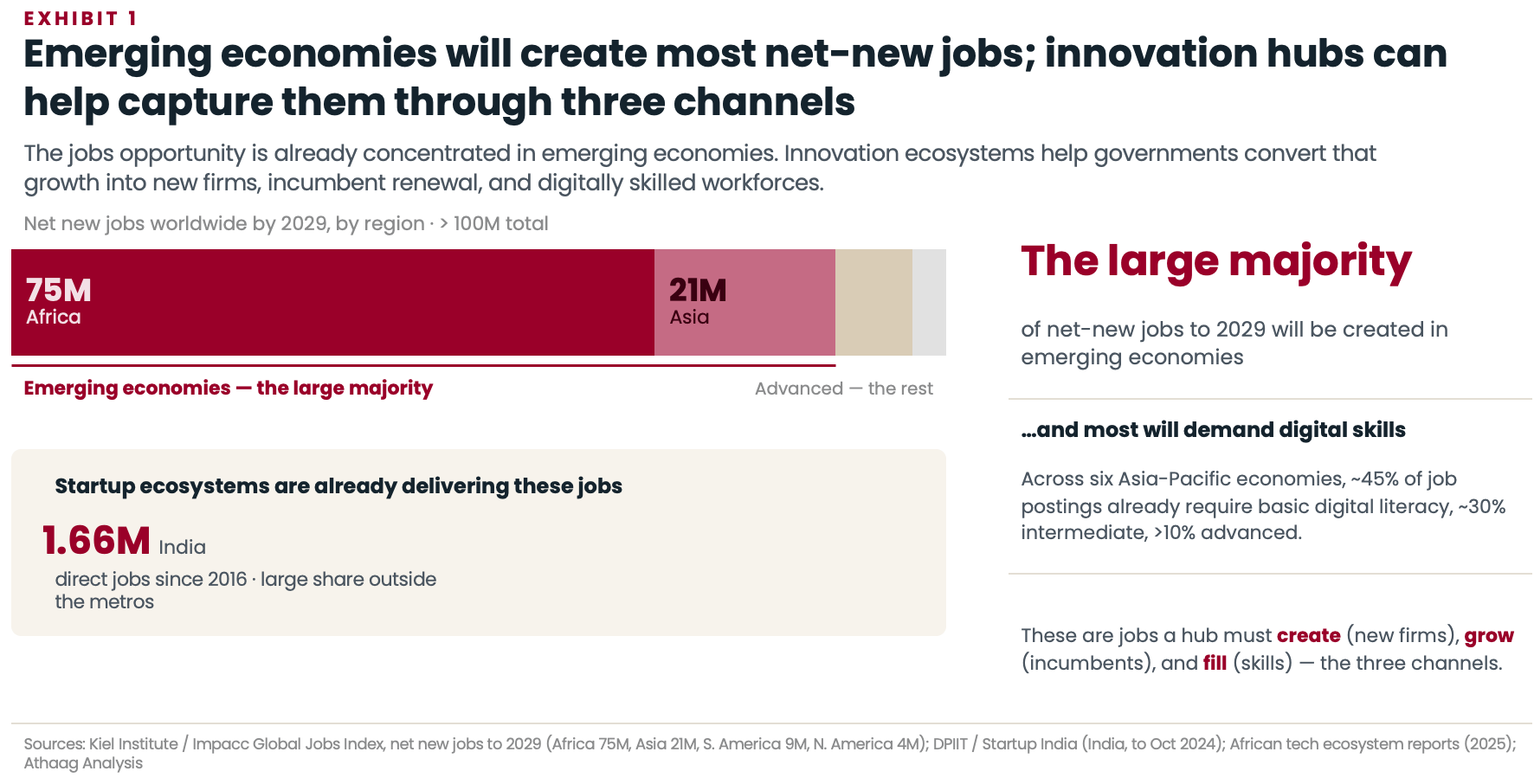
A working innovation hub creates jobs through three channels, not one — and only one of them is about innovation jobs in the narrow sense. It creates jobs directly, as new firms are founded and scale, hiring the founders, engineers, and specialists who build them. It grows jobs through incumbents, as established firms — banks, manufacturers, insurers, telcos — procure from, partner with, invest in, or acquire young innovators, and expand on the back of it. And it supports jobs broadly, across an economy where digital skills are becoming a baseline for ordinary work. The three channels compound, and the largest of them by headcount is not the startup layer at all. A hub that is judged only by the firms it incubates is measured on the smallest of its three contributions.
The broad channel is the easiest to see in the data, and it is the largest. Across emerging Asia, digital skills are spreading well beyond technology roles. In one six-economy analysis of job postings, roughly 45 percent of roles required at least basic digital literacy, close to 30 percent required intermediate skills, and more than 10 percent required advanced digital skills. In South-East Asia, an estimated 62 of every 100 workers will need training by 2030. India illustrates the scale of the shift: digital productivity could create roughly 60 million to 65 million jobs, while tens of millions of existing roles are displaced or transformed. These are not, for the most part, innovation jobs. They are ordinary occupations in agriculture, services, and industry that increasingly require digital capability. A hub does not create all of these jobs directly, but it can supply two things the wider economy needs to create them: skilled talent and deployable technologies.
The direct channel is the firms themselves — and this is the innovation-jobs channel in the strict sense. The stakes are not abstract: of the roughly 109 million net-new jobs expected worldwide by 2029, the large majority will be created in emerging economies, with an estimated 75 million in Africa and 21 million in Asia. Startup ecosystems are already contributing to that job base. India’s recognised startups created about 1.66 million direct jobs between 2016 and late 2024, and roughly 45 percent of those startups are based in Tier 2 and Tier 3 cities rather than the major metros. Africa’s tech startups created more than 1.2 million youth jobs in 2025 alone. These figures are not strictly comparable across regions or methods, but they point in the same direction: where innovation ecosystems function, young firms can become a fast-growing source of employment, including outside capital cities.
The incumbent channel is the most overlooked. A young firm may employ a few dozen people; the bank, insurer, manufacturer, or telco that adopts its technology may employ thousands. When an incumbent procures from, partners with, or acquires an innovator, the benefit is not limited to the startup’s headcount. It can also help the incumbent reach new customer segments, reduce costs, raise productivity, and protect existing jobs. The evidence is strongest at the mechanism level: studies of banking find that financial-technology adoption can raise firm productivity, and that service innovation sourced from startup ecosystems can feed into incumbent growth. This is why anchor firms matter as much as startups in a well-designed hub: they are not just tenants, but customers and partners whose own renewal can turn innovation into wider employment effects.
For a finance or industries ministry, this is the case for acting. An innovation hub, done well, is not a technology project. It is one of the few instruments that grows the firms of the future, modernises the firms of the present, and builds the skilled workforce for both — and spreads all three beyond the largest cities.
Innovation hubs create jobs through three reinforcing channels — not one.
There is an old assumption worth retiring: that emerging economies must first build the capacity to innovate before they can build ecosystems. The evidence now says otherwise.
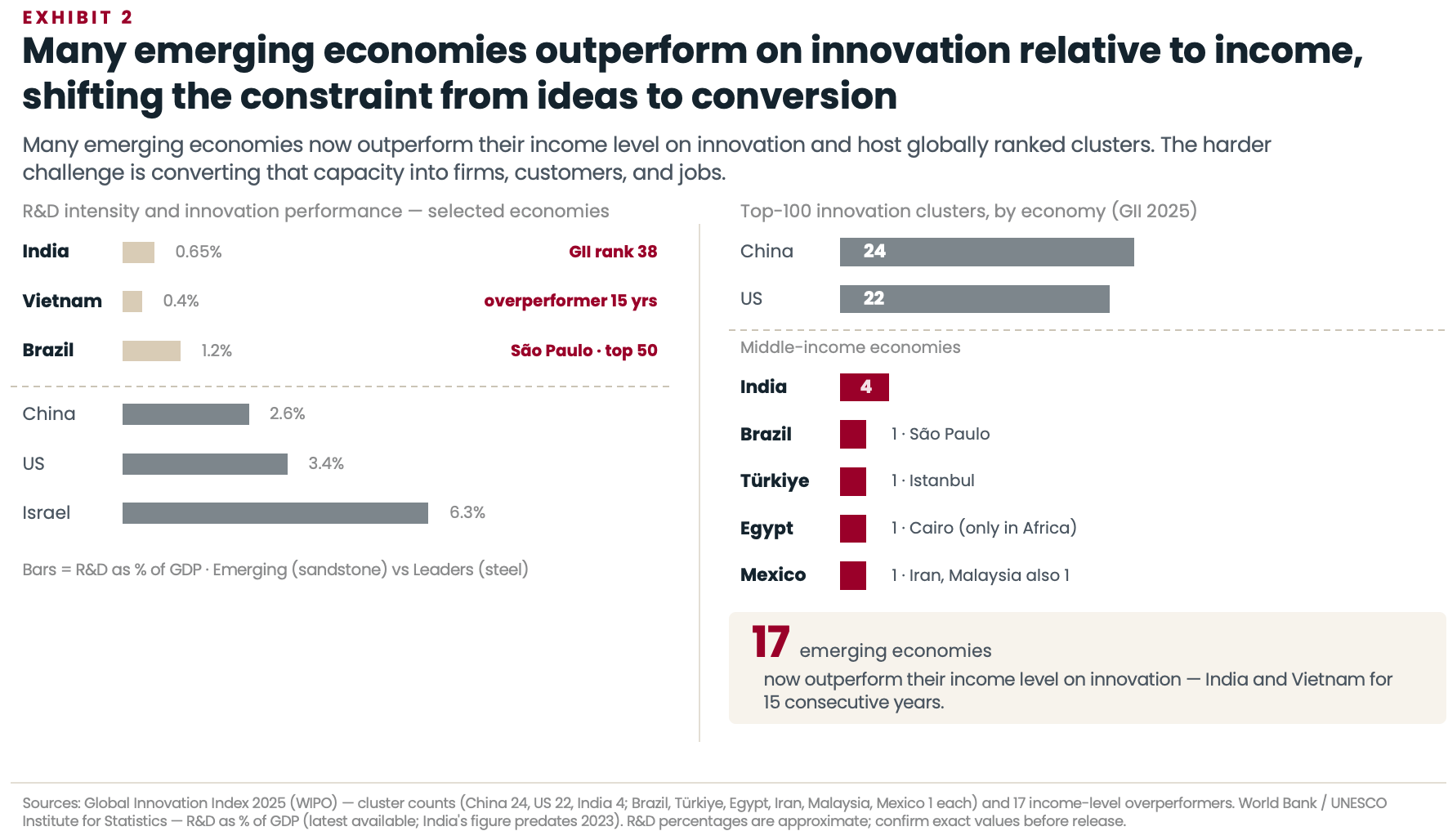
On the Global Innovation Index, a group of emerging economies consistently produces more innovation than their income levels would predict. In 2025, seventeen middle- and low-income economies were identified as innovation “overperformers,” with India and Vietnam sustaining that overperformance for fifteen consecutive years. Innovation strength is also no longer confined to rich-world cities: while China and the United States still dominate the top tier of the world’s science-and-technology clusters, middle-income economies now host a growing number of the global top 100 — India with four (led by Bengaluru, 21st worldwide), and Brazil, Türkiye, Egypt, Iran, Malaysia, and Mexico each with one, Cairo being the only such cluster on the African continent.
None of this means inputs no longer matter. Emerging economies still spend far less on research and development as a share of GDP than innovation leaders — typically well under 1 percent, compared with 2.5 percent to 5 percent in countries such as Korea, the United States, Israel, and China. But the comparison changes the policy question. If many emerging economies are already producing more innovation than their income and R&D intensity would predict, the binding constraint is not only the supply of ideas. It is the ability to convert those ideas into firms, customers, and jobs.
That is a question of design, not of capacity.
Five shifts separate a reform plan from a reform result.
If capacity is not the main constraint, the next place to look is conversion: where ideas, talent, and firms get stuck before they become scaled businesses and jobs. The pattern is visible in where capital flows.
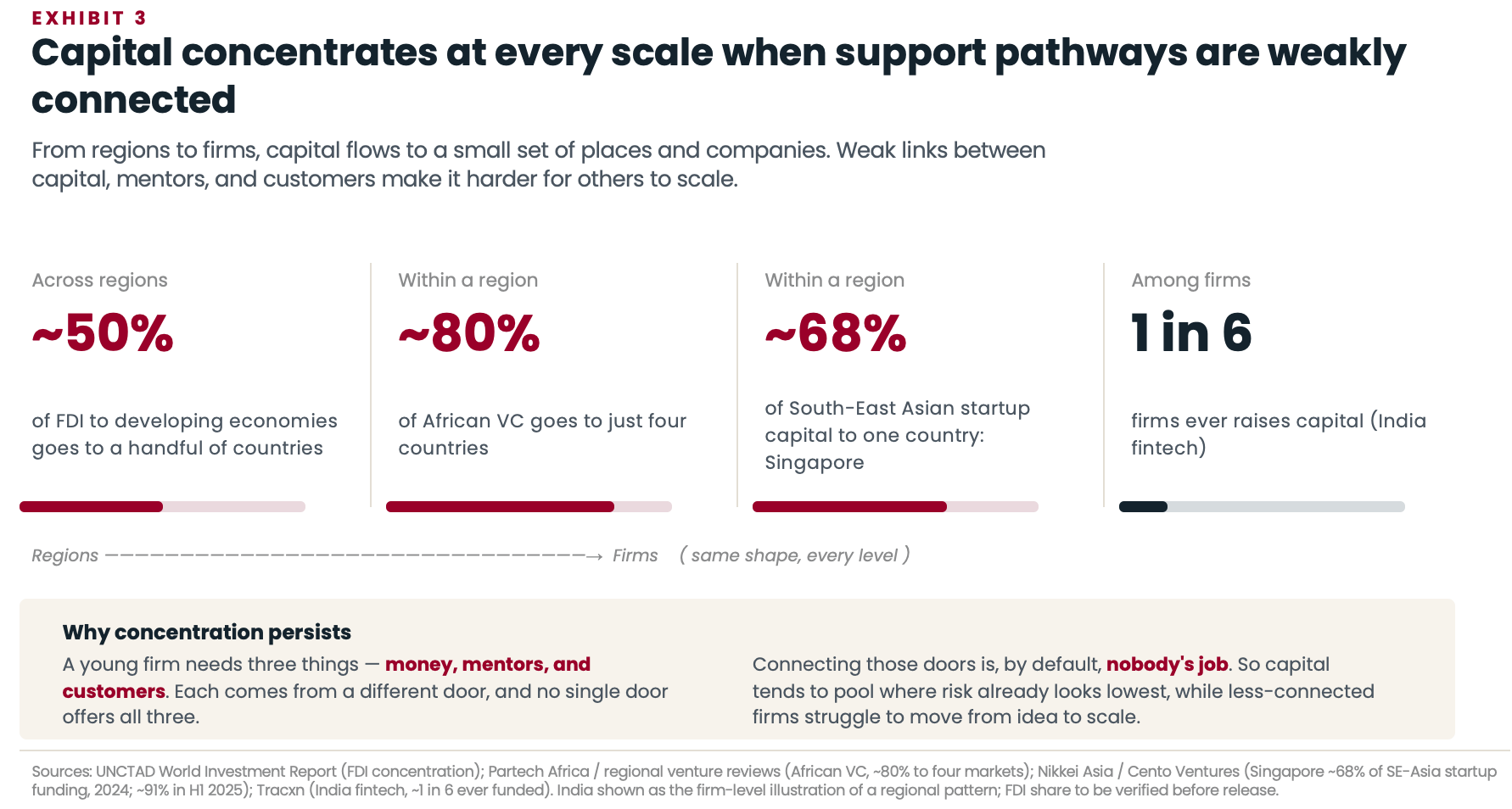
Capital in emerging economies concentrates. Of the foreign direct investment reaching developing economies, a large majority flows to a small number of countries. Within regions the concentration is starker still: in Africa, a handful of countries — the “big four” — have captured on the order of 80% of venture funding in recent years. In Southeast Asia, a single country, Singapore, absorbed roughly 68% of the region’s startup capital in 2024 — and closer to 90% in early 2025. And at the level of individual firms, the funnel narrows brutally: in India’s fintech sector — among the best-measured in the emerging world — only about one company in six has ever raised institutional funding, and a far smaller fraction reaches the growth stage.
Few countries, few cities, few firms. The same pattern repeats at every scale. It is not only a capital-market problem; it is a connection problem. The pieces of the ecosystem exist, but the pathways between them are too weak for most firms to move from idea to scale.
Here is the mechanism, in plain terms. A young firm needs three things to grow: money, mentors, and customers. In most emerging ecosystems, each of these is available — but from a different door, and no single door offers all three. University incubators tend to offer mentorship and space, but not customers. Venture accelerators offer capital and advice, but rarely market access. Corporate programmes offer market access and mentoring, but not funding. A founder must assemble her own ecosystem, stitching together relationships across institutions that were never designed to work together — and most founders stall somewhere in the stitching.
And connecting those doors is, by default, nobody’s job. Each institution optimises for its own mandate. The fund is measured on the returns of its portfolio, not on the health of the pipeline beneath it. The university is measured on research and teaching, not on whether its graduates staff local firms. The regulator is measured on stability, not on how many firms reach scale. Every actor is rational. The connections between them fall into the gaps between mandates — and stay there until someone is made responsible for them.
Five decisions that turn assets into a system
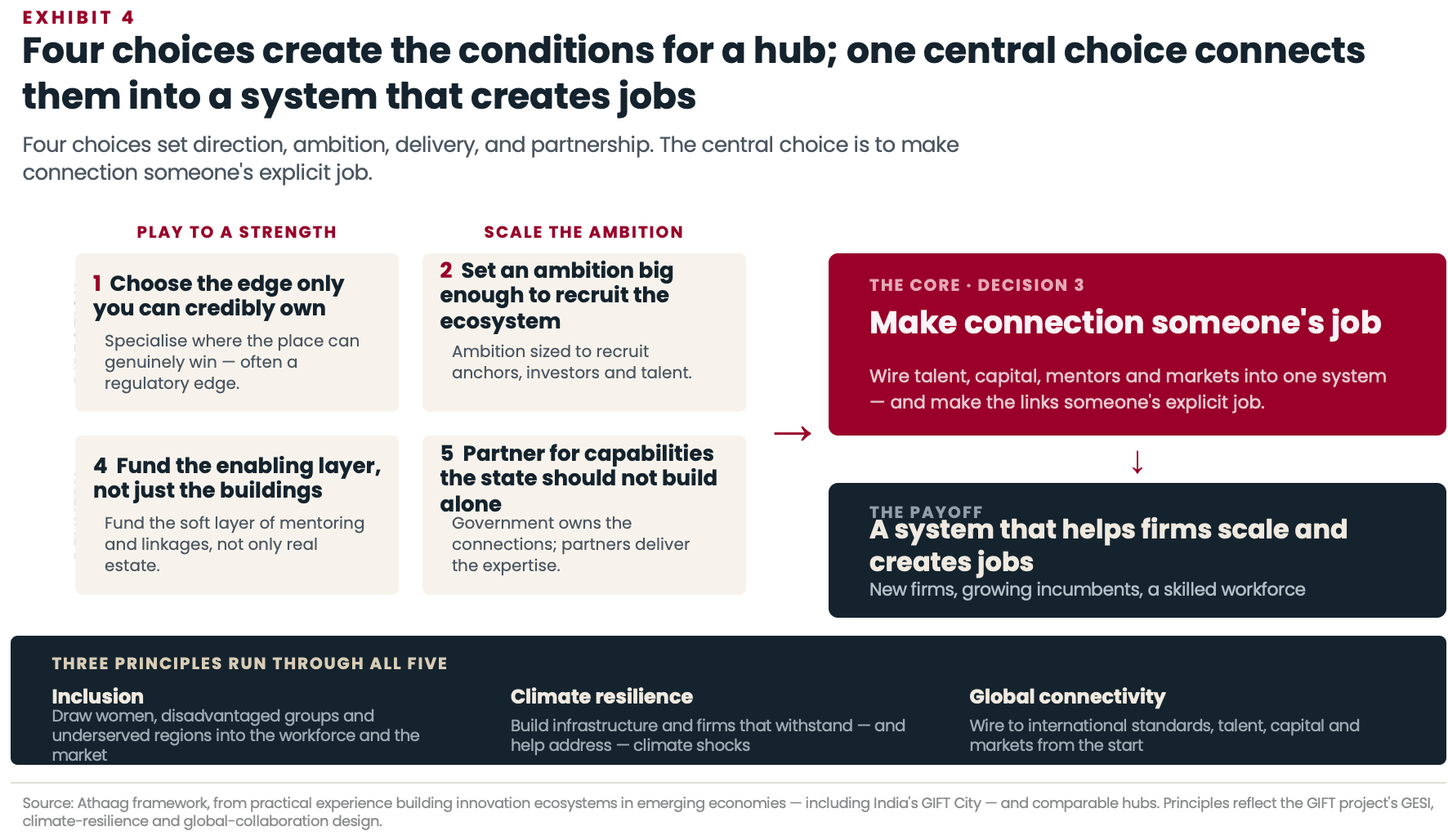
What distinguishes functioning hubs is not a longer list of programmes, but a small number of operating choices that make the programmes reinforce one another. Five decisions matter most. Four create the conditions for density, ambition, delivery, and partnership. One sits at the centre: making connection someone’s explicit job.
Drawn from practical experience building innovation ecosystems in emerging economies — including India’s GIFT City International Fintech ecosystem — and checked against the common features of functioning hubs elsewhere, five decisions stand out. They are not a sequence to be completed in order; they are decisions a government makes, and keeps making, as it builds.
Choose one sector to build around, and choose it because your location is already strong in it — not because it is fashionable.
A hub that tries to host every sector at once concentrates nothing, and concentration is what makes connections worth building. Focus creates the density of firms, talent, and capital that lets a network form. The discipline is to identify where your economy, city, or zone has a genuine right to win — and to build there.
That edge is often regulatory or locational rather than sectoral. A jurisdiction that can offer clarity, a sandbox, or a licensing regime that ordinary locations cannot gives firms a reason to cluster. A special economic zone built around a dedicated regulator, for instance, competes on something rivals cannot easily copy. Name the honest edge, and anchor the hub to it.
Aim beyond your current size.
The partners a hub most needs — anchor firms, global investors, experienced talent — are recruited by ambition, not by present scale. A goal framed around today’s footprint gives them no reason to move. A credible, outsized goal does. It also justifies the patience the work requires: connecting an ecosystem takes the better part of a decade, and a small goal will not hold political and financial commitment across that span.
The most successful hubs are framed from the outset as regional or global players, not domestic office parks — an ambition deliberately larger than their early footprint, precisely because the ambition is part of how they attract the firms and institutions that will fill them.
Connection operates at two levels: the ecosystem level, where institutions must work as one system; and the firm level, where each growing company must be able to move from talent to funding to customers without falling through institutional gaps.
At the level of the hub, it means joining together the capacities that are normally scattered across separate institutions: talent (skilling and training), enterprise (incubation and acceleration), and research (innovation and R&D). In most economies these sit in different organisations, on different budgets, answering to different ministries — a university does the research, an agency does the skilling, a private accelerator does the enterprise support, and none is responsible for the links between them. The design move is to fuse them into a single connected system. Bringing skilling, entrepreneurship, and research together under one connected design — rather than leaving them scattered across separate institutions — is the feature most consistently present in hubs that work, and it is the idea at the core of purpose-built institutes such as the one anchoring GIFT City.
At the level of the individual firm, connection means ensuring the three things a firm needs — money, mentors, and customers — actually reach it continuously as it grows, rather than arriving in disconnected fragments. This is the practical answer to the funnel collapse: firms stall in the middle because the support that exists is not sequenced or joined. Designing the connections means mapping where firms stall and wiring the specific links — introductions to later-stage capital, to anchor customers, to specialist mentors — that carry a firm across the gap.
The most valuable of these links is often the one between the young firm and the established one. Large incumbents — banks, insurers, manufacturers, telcos — cannot renew themselves on their core business alone; a firm that runs only on its existing products eventually plateaus. Its next phase of growth tends to come from outside: the new capabilities, products, and models it procures from, partners with, invests in, or acquires from young innovators. This makes the incumbent the startup’s most important customer, and the startup the incumbent’s route to renewal — a single connection that grows both firms at once. Yet in most ecosystems it is precisely the link that is missing: the bank and the fintech operate in the same city and never transact. Designing it deliberately — putting anchor firms and innovators in structured contact, as the best hubs do by co-locating banks, insurers, and global capability centres alongside the startups that serve them — is among the highest-return connections a hub can make.
Neither level happens on its own. Connection is a job that must be owned — assigned to an institution whose explicit purpose is the links between players, because those links will otherwise remain, as they are in most ecosystems, nobody’s responsibility.
The most common and most expensive mistake is to treat the hub as a construction project.
Buildings are visible, fundable, and satisfying to open — and they are necessary. But they are not what makes an ecosystem work. The decisive work is less photogenic: mentoring, employer-linked training, structured introductions to customers, programmes that create circulation between firms, and governance that makes collaboration routine rather than exceptional.
The best hubs build world-class physical infrastructure — and are explicit that the infrastructure is not the point. The enabling layer is what turns floor space into a functioning ecosystem, and it is the part most likely to be under-budgeted precisely because it cannot be inaugurated with a ribbon.
Partner for capabilities the state should not build alone.
No government runs world-class acceleration, mentoring, and innovation support on its own, and none should try to build that capability from scratch.
The better model is partnership: bring in proven operators — accelerators, corporate partners, universities, specialist mentors — and make the government’s own role the one only it can play: convening the partners and owning the connections between them. The state does not need to be every actor in the ecosystem. It needs to assemble the right actors and take responsibility for the links.
This is also where financing fits. Markets will not fund every part of an ecosystem on their own: early higher-risk capital, the soft enabling layer, and the patient decade-long build often need catalytic support. Development finance is designed for exactly these gaps. Several emerging-market hubs, including GIFT City with support from the Asian Development Bank, have used it to fund connective work that neither private capital nor annual public budgets are well placed to carry alone.
Own the handoffs, not just the agencies
Across recent reform programmes, the binding constraint was rarely the broad category called “red tape.” It was a more specific failure in process design, inter-agency coordination, measurement, or enforcement.
The five decisions are not neutral about who the ecosystem is for or how long it lasts. Three principles should run through every one of them.
An ecosystem that circulates opportunity only among a narrow, already-connected group reproduces the concentration it was meant to solve. Inclusion means deliberately drawing women, disadvantaged groups, and underserved regions into both the workforce the hub trains and the markets its firms serve — setting real targets for female founders and trainees, appointing mentors who can reach under-represented groups, and backing firms that build products for the financially excluded, not just the already-banked.
The physical and financial base of the ecosystem should be built to withstand climate and other shocks — resilient infrastructure, diversified funding — and its firms should be oriented toward solutions to those shocks rather than exposure to them. In sectors like fintech, that means backing innovation in climate and green finance as a deliberate part of the portfolio, not an afterthought.
For most emerging economies the decisive markets, capital, and talent lie abroad. An ecosystem wired to international standards, research networks, and export markets from the start gives its firms a path to the customers and capital that domestic markets alone cannot provide; one that stops at the national border leaves its firms’ hardest constraint unsolved.
The test: can firms and talent grow without leaving?
Strip away the framework and one test remains — a question a minister or secretary can ask of any hub, including one already built.
If the answer is yes, the hub is more than a place. It is a system that can produce firms, jobs, and wider renewal. If the answer is no — if the firm must go abroad for capital, or the graduate must move to another city for work — then what exists is a collection of good initiatives, not an ecosystem. The jobs will accrue wherever the connections are, which may not be at home.
The building blocks are already within reach of most emerging economies. The innovation capacity is proven. The prize — firms and skilled jobs, spread beyond the largest cities — is real and large. What remains is the breakthrough: the deliberate, unglamorous, decade-long work of connecting the pieces into a system. That work is a choice. Governments that make it will turn their innovation strategies into innovation systems — and their hubs into jobs.
Capital responds less to reform intent than to the time, cost, predictability, and trust firms experience on the ground. Five execution shifts that matter most.
Perspectives on emerging markets, investment climate reform, trade policy, and
private sector development — from people who have worked in these systems.